
Affiliate Disclosure: If you purchase via swindonpost.co.uk, we may receive commission which supports our work creating jobs in Swindon.
| Road | Direction |
|---|---|
| Drove Road | N |
| County Road | E |
| Fleming Way | SE |
| Shrivenham Road | S |
| Queens Drive | W |
First time driving it?
Take your time. Treat each mini-roundabout separately – give way to the right. If you miss your exit, go around again. Most locals find it easier than it looks.
What is the Swindon Magic Roundabout?
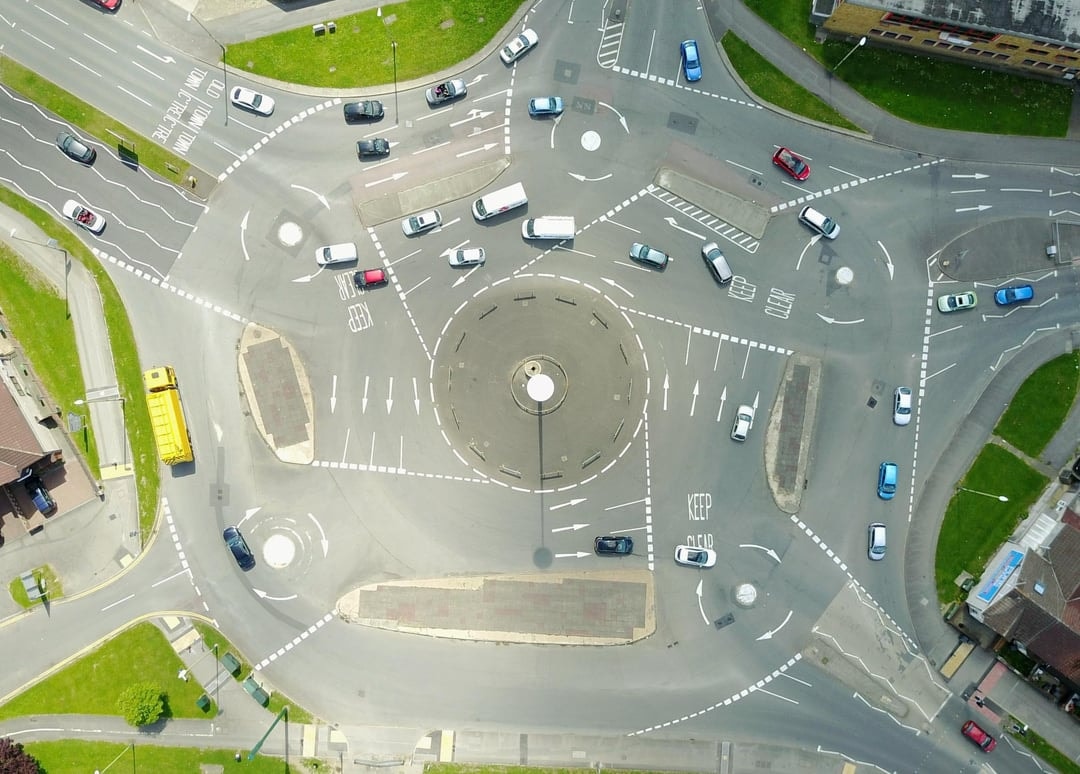
The Magic Roundabout is in central Swindon. Officially called the County Islands Roundabout, it has five mini-roundabouts in a circle around a central anti-clockwise roundabout. It opened in September 1972 and is one of the best-known junctions in the UK.
Key Information
- Location
- Central Swindon, near County Ground football stadium
- Opened
- September 1972
- Designer
- Frank Blackmore, British Transport and Road Research Laboratory
- Official Name
- County Islands Roundabout
- Connecting Roads
- Drove Road, County Road, Fleming Way, Shrivenham Road, Queens Drive
- Safety Record
- Relatively few accidents despite its reputation
The history of the Magic Roundabout
The Magic Roundabout was designed by Frank Blackmore of the British Transport and Road Research Laboratory (now TRL) to replace the old Drove Roundabout, which had seen numerous accidents and was considered dangerous. The innovative design was implemented to improve traffic flow and reduce accidents at this busy junction near Swindon's County Ground football stadium.
When it first opened in 1972, police officers were stationed at each of the five mini-roundabouts during the pilot phase to assist drivers and manage the new, unfamiliar design. The roundabout quickly gained its nickname "Magic Roundabout" from the popular children's television series of the same name, and the name eventually became official, even appearing on direction signs.
How does the Magic Roundabout work?
The layout is straightforward once you understand it:
- Central Roundabout: Traffic flows anti-clockwise around the inner central circle
- Five Mini-Roundabouts: Traffic flows clockwise around each of the five outer mini-roundabouts
- Flexible Routing: Drivers can take the shortest route between entry and exit points, reducing time spent on the junction
The design lets drivers take a more direct route to their exit instead of going all the way around a single roundabout, which can reduce congestion.
How to navigate the Magic Roundabout
If you have not driven it before, these tips may help:
- Take your time: Don't rush - approach slowly and observe the traffic flow
- Give way to the right: Standard roundabout rules apply to each mini-roundabout
- Plan your route: Know which exit you need before entering
- Watch for pedestrians: Be extra vigilant for pedestrians crossing between the mini-roundabouts
- Stay calm: If you miss your exit, you can easily go around again
Treat each mini-roundabout on its own while staying aware of the overall flow. Many local drivers find it easier than it looks, and the design has been shown to reduce congestion compared to a single large roundabout.
How many roundabouts in the Magic Roundabout Swindon?
The Magic Roundabout has six roundabouts in total: five mini-roundabouts arranged in a circle, plus one central anti-clockwise roundabout in the middle. Traffic flows clockwise around each of the five outer mini-roundabouts, and anti-clockwise around the central circle. The official name is the County Islands Roundabout.
Who designed the Magic Roundabout Swindon?
The Magic Roundabout was designed by Frank Blackmore of the British Transport and Road Research Laboratory (now TRL). He created the innovative layout to replace the old Drove Roundabout, which had a poor safety record. The design has since been replicated in Hemel Hempstead and elsewhere, but Swindon's is the original and most famous.
How many accidents on the Magic Roundabout in Swindon?
The Magic Roundabout has a relatively good safety record over more than 50 years. Despite its reputation as one of the most challenging junctions, accident rates have remained low since it opened in 1972. The design – replacing the old Drove Roundabout – was specifically intended to reduce crashes.
The mini-roundabout layout has proved effective. Exact figures vary by year; for up-to-date statistics, check Swindon Borough Council or the Department for Transport.
Safety record and reputation
The Magic Roundabout is widely seen as an effective traffic solution. Its unusual layout has made it famous; in past surveys it has been named among the junctions drivers find most challenging, but accident figures have remained low.
Location and access
The Magic Roundabout is located in central Swindon, near the County Ground football stadium. It connects several major roads including:
- Drove Road
- County Road
- Fleming Way
- Shrivenham Road
- Queens Drive
The junction is easy to reach by car and well signposted. Visitors often stop to look at it from the pavement before or after driving through.
Why is it called the Magic Roundabout?
The roundabout's nickname comes from the popular 1970s children's television series "The Magic Roundabout", which featured characters like Dougal the dog, Zebedee, and Florence. The name stuck because the roundabout's design seemed almost magical in its complexity and efficiency. What started as an unofficial nickname has now become the official name, recognised on road signs and in official documentation.
Cultural significance
The Magic Roundabout is closely linked with Swindon's identity. It appears in travel guides, television programmes, and social media. Similar designs have been built elsewhere, but Swindon's remains the best known.
Explore more of Swindon
Near the County Ground – combine with a Swindon Town match or visit the Designer Outlet.
Local InformationFrequently asked questions
Is the Magic Roundabout dangerous?
It has a good safety record with relatively few accidents. The design is effective at managing traffic flow.
Can I walk around the Magic Roundabout?
Yes. There are pedestrian crossings and footpaths. Take care when crossing, especially between the mini-roundabouts.
When was the Magic Roundabout built?
It opened in September 1972, so it is over 50 years old.
Are there other Magic Roundabouts?
Similar designs exist elsewhere, including Hemel Hempstead. Swindon's is the original and the most well known.
How many accidents happen on the Magic Roundabout Swindon?
Accident rates have stayed low despite the junction's complexity. The design reduces conflict points compared to a conventional roundabout, and local drivers generally find it manageable.